Wiz’s CTO on PHP2Shell and the coming ‘vulnpocalypse’
Two critical bugs discovered in PHP, which powers roughly 70% of websites, have prompted widespread emergency patching efforts across organizations.
Stories tagged by our AI curator.
Two critical bugs discovered in PHP, which powers roughly 70% of websites, have prompted widespread emergency patching efforts across organizations.
CISA adds two PHP2Shell vulnerabilities (CVE-2026-109618 and CVE-2026-109619) to its Known Exploited Vulnerabilities catalogue, with a deadline for federal agencies to patch by October 29.
AI is uncovering new security vulnerabilities in web infrastructure faster than they can be patched, raising concerns about internet safety.
U.S. government warns that hackers are exploiting critical vulnerabilities in PHP, the software used in 70% of web applications.
Security experts discovered another critical PHP2Shell vulnerability with no emergency patch planned.
PHP disclosed a third security vulnerability (CVE-2026-115560) that could allow code execution on web servers, announced two days after emergency patches for earlier PHP2Shell flaws.
Opinion piece argues that the PHP2Shell vulnerability illustrates broader systemic risks from technical debt in legacy systems and the dual-use nature of AI-assisted cybersecurity tools.
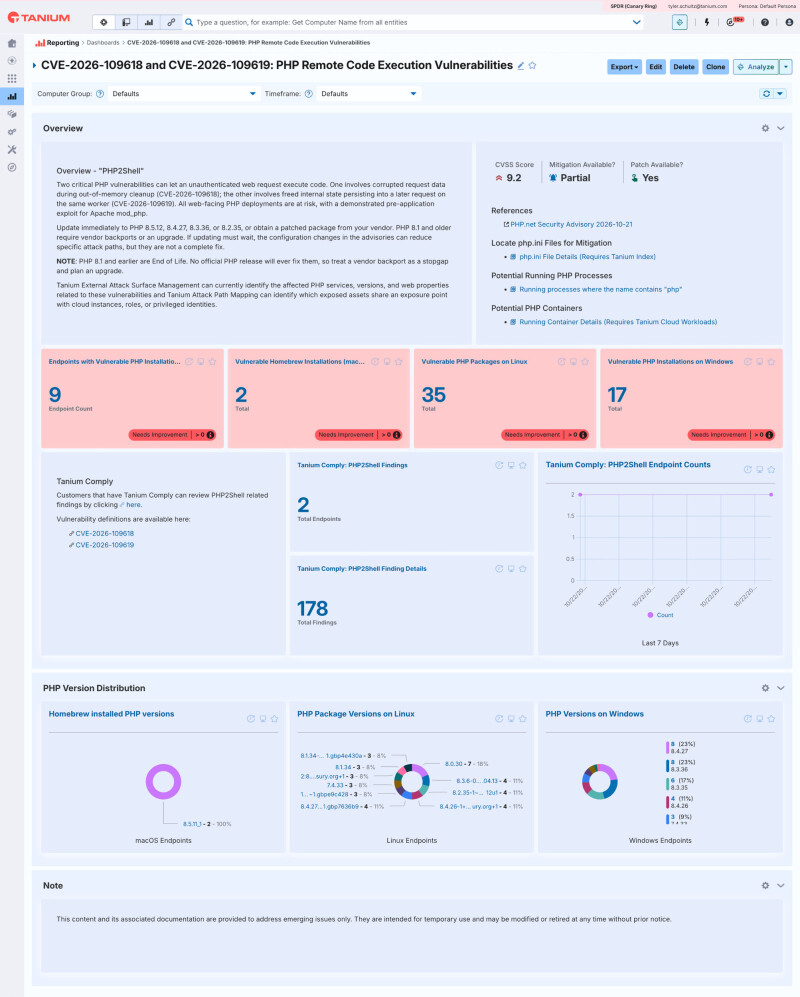
Two critical PHP vulnerabilities (PHP2Shell) allow unauthenticated remote code execution on servers. Patches are available but finding all affected PHP installations remains challenging.
Two critical PHP vulnerabilities (CVE-2026-109618 and CVE-2026-109619, both rated 9.2) could allow attackers to execute arbitrary code on servers running PHP, which powers approximately 70% of websites.
Two critical security flaws in PHP, the programming language powering most of the web, posed a significant threat to internet infrastructure.
Security researchers used AI tools to discover long-standing vulnerabilities in PHP, which subsequently enabled AI-assisted attacks on the programming language.
The PHP Foundation and FBI warned of significant security vulnerabilities in PHP, the scripting language powering the majority of websites worldwide.
The PHP Foundation operates with minimal resources, including only one full-time staff member, despite PHP's critical role in powering the internet.
Critical PHP vulnerabilities disclosed this week pose security and business continuity risks; article discusses mitigation strategies while systems are patched.
EFF argues for increased funding and support of open-source projects like PHP, which powers 70% of websites but is maintained by underfunded volunteers, after a recent major vulnerability incident.
Researchers discovered a third PHP remote code execution vulnerability related to PHP2Shell, but the PHP Foundation will not issue an emergency fix due to its unlikely real-world impact.
Cybersecurity leaders warn that AI tools are accelerating the discovery of critical vulnerabilities in internet infrastructure, with experts predicting a 'vulnerability tsunami' following discovery of a severe PHP bug.
A PHP vulnerability affecting 70% of websites was discovered using OpenAI's AI model; it leaked before patches were released and hackers began exploitation.